

Calm Mornings with kids often feel intense because many emotional and practical demands collide within a short period. Parents juggle time pressure, household responsibilities, and work readiness while children shift from sleep into structured expectations. Wellness educators commonly observe that morning stress is rarely about discipline and more about nervous system readiness, routine design, and emotional pacing.
Calm mornings do not mean silence, perfection, or rigid schedules. They reflect a household rhythm where adults and children move through transitions with less urgency and fewer emotional spikes. Creating this rhythm involves understanding brain development, reducing unnecessary stress triggers, and using supportive lifestyle practices that fit real family life.
This article explores how to create calm mornings with kids using neuroscience-informed routines, mindfulness principles, sensory awareness, and realistic preparation strategies. The focus remains educational and lifestyle-based, offering practical guidance that supports emotional wellbeing without making medical or therapeutic claims.
Understanding the Reality of Morning Stress in Families
Morning stress develops because children and adults are asked to transition quickly from rest into performance. Children move from sleep into rules, timelines, and social expectations, while adults manage responsibility and time awareness. Developmental research shows that emotional regulation skills are still forming throughout childhood, making rushed transitions especially challenging.
Parents experience their own stress response during mornings, often shaped by work demands and caregiving load. Occupational health research links time pressure with reduced emotional patience. When adult stress rises, tone and body language shift, which children quickly perceive and mirror.
Viewing morning stress as a shared family experience changes how routines are approached. Instead of focusing on correcting behavior, families can reduce friction by adjusting expectations, pacing, and environmental cues. Calm mornings become a lifestyle goal supported by structure and emotional awareness.
The Neuroscience of the Morning Rush
Amygdala activation and emotional reactivity
Morning stress frequently activates the amygdala, the brain area responsible for detecting threat. Raised voices, rushing, or repeated instructions signal urgency, which the brain interprets as danger. In children, this response often appears as resistance, emotional outbursts, or withdrawal rather than cooperation.
When the amygdala is active, the prefrontal cortex becomes less accessible. The prefrontal cortex supports focus, planning, and impulse control, skills needed for following routines. Neuroscience research shows that stress reduces these abilities temporarily, explaining why logic and reminders often fail during rushed mornings.
Lowering amygdala activation helps create calmer mornings with kids. Predictable routines, steady tone, and reduced time pressure signal safety to the nervous system. This keeps higher-level thinking available and supports smoother transitions without escalating conflict.
Prefrontal cortex limitations in early hours
The prefrontal cortex develops gradually and functions less efficiently during early morning hours. Sleep inertia and circadian rhythms influence attention, flexibility, and emotional regulation after waking. Children often need time and structure before they can manage multi-step tasks independently.
Expecting immediate compliance places unrealistic demands on a developing brain. Developmental psychology emphasizes aligning expectations with neurological readiness. Calm mornings account for these limits by simplifying routines and reducing simultaneous demands.
Supporting prefrontal engagement involves clear sequencing and external cues. Visual schedules and predictable order reduce reliance on working memory. These adjustments help children move through routines with less frustration and fewer emotional reactions.
You may also interested in:
Mindfulness Activities to Do With Kids: A Complete Guide to Building Emotional Strength
The Ultimate Morning Routine Checklist for Working Moms: Reclaim Your Peace 2026
Gentle Parenting vs Mindful Parenting: A Calm, Evidence Informed Guide for Modern Families in 2026
Mirror Neurons and Contagious Stress
Mirror neurons allow humans to sense and copy emotional states in others. Children are especially sensitive to adult tone, posture, and facial expression. When parents appear hurried or tense, children often absorb that stress without conscious awareness.
This biological process explains why calm parental behavior influences cooperation more than repeated instructions. Emotional regulation is demonstrated through presence rather than explanation. Calm mornings depend on adult regulation as much as child behavior.
Wellness educators often highlight the importance of modeling calm. Slower movements, neutral expressions, and measured speech communicate safety. Over time, children associate mornings with predictability instead of urgency, reducing emotional escalation.
Preparation as a Lifestyle Strategy, Not a Productivity Hack
Streamlining logistics the night before
Evening preparation supports calmer mornings by reducing decision-making demands. Laying out clothes, packing bags, and preparing meals the night before lowers cognitive load during emotionally sensitive hours. This approach aligns with lifestyle balance rather than efficiency culture.
Children benefit when they participate in preparation at age-appropriate levels. Involvement builds predictability and responsibility without pressure. Occupational therapy frameworks often note that preparation supports executive function development through repetition.
Preparation works best when routines remain flexible. Missed steps or changes are expected. The goal is emotional ease, not flawless execution or rigid control.
Bedtime consistency and emotional readiness
Sleep quality strongly influences morning regulation. Children with inconsistent bedtimes often show lower frustration tolerance and increased emotional reactivity. Sleep research links regular routines with improved mood stability and attention.
Consistent bedtime rituals support circadian rhythms and reduce morning cortisol surges. This does not require early bedtimes for every family, but it does rely on predictability. Regular sleep patterns help the nervous system transition more smoothly into daytime demands.
Parents also benefit from improved sleep. Better rest increases emotional bandwidth, supporting calmer communication and patience during morning routines.
Reducing Cognitive Load in Morning Routines

Simplifying tasks and expectations
Cognitive load refers to the mental effort required to process information and complete tasks. Mornings often overload children with instructions, time awareness, and emotional cues. Simplifying routines reduces overwhelm and supports cooperation.
Limiting morning responsibilities to essentials increases success. Tasks such as room organization or homework checks can happen later. Morning routines function best when expectations are clear, minimal, and consistent.
This approach supports emotional safety rather than compliance. Children who experience achievable expectations are more likely to engage calmly. Reduced pressure often leads to better cooperation over time.
External supports for working memory
Children rely on external supports when working memory is limited. Visual schedules, timers, and checklists reduce the need to remember steps independently. These tools are widely recommended in educational and occupational therapy settings.
External cues replace repeated verbal prompting, which can increase frustration. Over time, routines become internalized through repetition. This reduces conflict and emotional intensity.
Parents benefit from fewer verbal reminders as well. The household atmosphere becomes quieter and more predictable, supporting calmer mornings overall.
Visual Routine Supports and Predictable Flow
Building executive function through repetition
Executive function skills develop through consistent practice within supportive environments. Morning routines provide daily opportunities to strengthen sequencing, task initiation, and completion. Predictable flow helps children know what comes next.
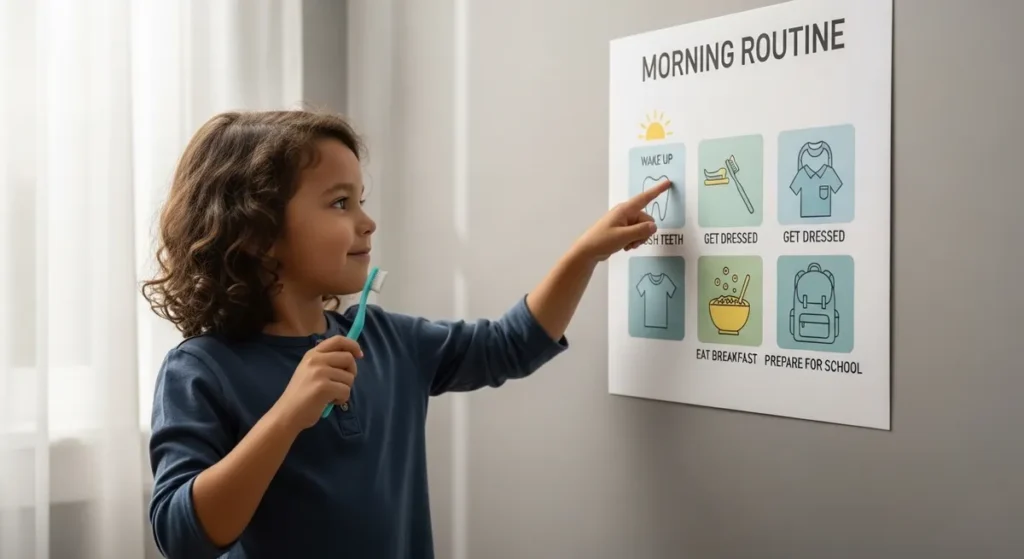
Visual routine charts make expectations concrete. Children see the sequence rather than relying on memory. This clarity reduces anxiety and improves engagement.
Simple charts used consistently are more effective than complex systems. Calm mornings emerge through familiarity rather than novelty.
Age-appropriate visual tools
Different ages benefit from different visual supports. Younger children respond well to picture-based charts, while older children often prefer written checklists. Photos showing completed tasks reinforce progress and completion.
First-then boards clarify transitions without negotiation. These tools align with educational best practices for supporting self-regulation. They reduce emotional friction by removing ambiguity.
Visual supports should feel helpful rather than controlling. When children experience autonomy within structure, cooperation increases naturally.
Sensory Regulation in Morning Transitions
Proprioceptive input and body awareness
Proprioceptive input comes from muscles and joints and supports body awareness. Activities involving pushing, lifting, or resistance provide organizing sensory feedback. Many children seek this input when they feel unsettled.
In the morning, brief proprioceptive activities help children shift from rest to movement. Carrying a backpack, wall push-ups, or slow animal walks are commonly used strategies. These practices are often included in sensory-informed routines.
Sensory input functions as regulation support, not behavior control. When children feel physically organized, emotional regulation often improves alongside it.
Vestibular input and gentle movement
Vestibular input relates to balance and movement through space. Gentle rocking, stretching, or slow yoga-style motions provide calming sensory input. These movements help prepare the nervous system without overstimulation.
During mornings, slower vestibular activities are more supportive than fast or intense motion. Gradual activation aligns with natural circadian shifts. This approach supports calmer transitions into daily routines.
Parents can integrate gentle movement into existing habits. Stretching while dressing or walking slowly to the door adds regulation without extending the schedule.
Sensory environment adjustments
Environmental factors influence morning stress levels. Lighting, sound, and background noise can either support regulation or increase arousal. Soft lighting and moderate sound levels help maintain emotional balance.
Some families find consistent background music useful for signaling transitions. Others prefer quiet. Sensory preferences vary, and observation guides effective adjustments.
Small environmental changes often lead to noticeable emotional shifts. Sensory-friendly spaces support calm mornings without requiring behavioral correction.
Mindfulness as a Lifestyle Support Tool
Mindfulness defined in family contexts
Mindfulness refers to present-moment awareness practiced without judgment. In family life, mindfulness functions as a lifestyle habit rather than a formal exercise. It emphasizes noticing emotional states and responding with intention.
Mindfulness does not require meditation sessions during busy mornings. It involves steady breathing, slower pacing, and awareness of tone. These elements fit naturally into daily routines.
Wellness educators describe mindfulness as supportive rather than therapeutic. Its role is to increase awareness, not to change emotions or eliminate stress.
Brief regulation practices for mornings
Short breathing practices support nervous system regulation. Slow exhalations encourage the body’s calming response. These practices often take less than a minute.
Physical connection combined with breathing, such as a brief hug, supports co-regulation. Attachment research highlights physical closeness as a stabilizing factor for children. These moments fit easily into morning routines.
Consistency matters more than duration. Regular brief practices influence emotional tone over time without adding pressure.
Family Connection Rituals and Emotional Safety
Predictable rituals and emotional security
Connection rituals provide emotional anchors during transitions. Simple rituals such as listening to the same song or sharing a quiet moment create familiarity. Emotional security supports cooperation without enforcement.
Rituals act as signals rather than tasks. They gently mark transitions, reducing resistance. Over time, children associate rituals with safety instead of urgency.
These practices strengthen relational trust. Calm mornings grow from connection rather than control.
Cultural and family flexibility
Connection rituals differ across families and cultures. Some families value quiet reflection, while others prefer music or shared movement. There is no universal approach that fits every household.
Rituals work best when they feel supportive rather than obligatory. Flexibility prevents burnout and rigidity. Adjustments over time reflect changing family needs.
As children grow, rituals may evolve. What supports a young child may differ for adolescents. Calm mornings adapt alongside development.
PACE Parenting and Morning Emotional Tone
Playfulness and acceptance in routines
PACE parenting emphasizes playfulness and acceptance as emotional supports. Light humor or imaginative language can ease tension during routine tasks. Acceptance validates feelings without endorsing behavior.
This approach reduces power struggles. Children respond more positively when they feel understood. Emotional validation supports cooperation indirectly.
Playfulness must remain respectful and attuned. The goal is emotional ease, not distraction.
Curiosity and empathy as regulation supports
Curiosity reframes resistance as information rather than defiance. Observing patterns helps parents adjust routines without blame. Empathy acknowledges difficulty without lowering expectations.
These elements support regulation without lecturing. Children receive guidance within a context of understanding. Calm mornings rely on emotional safety.
PACE functions as a relational framework, not a quick fix. Its impact grows with consistency.
Parental Emotional Regulation and Self-Support
The oxygen mask principle in parenting
Parental regulation directly influences child regulation. The oxygen mask principle highlights caring for adult emotional needs to support children effectively. This is a lifestyle consideration rather than a trend.
Recognizing personal stress signals allows intervention before escalation. Small adjustments such as slower breathing or realistic expectations support steadiness.
Supporting adult regulation does not require elaborate routines. Simple awareness often makes the greatest difference.
Thought patterns and emotional tone
Unhelpful thought patterns amplify stress. Rigid expectations or catastrophic thinking increase urgency. Shifting toward neutral interpretations supports calm.
Reframing does not deny challenges. It allows flexibility and acceptance. This mental shift affects tone and body language.
Emotional tone sets the pace of the morning. Calm thoughts encourage calm communication.
Encouraging Independence Without Pressure
Choice and autonomy within structure
Offering limited choices supports autonomy while maintaining routine flow. Choosing between two options reduces resistance. Choice fosters ownership without overwhelm.
Autonomy increases motivation naturally. Children engage more willingly when involved. This aligns with developmental psychology principles.
Choices should remain bounded and predictable. Too many options increase cognitive load.
Gradual reduction of prompts
Verbal prompts can fade as routines become familiar. Gradual reduction supports independence without sudden withdrawal. This respects developmental readiness.
Children benefit from recognizing progress. Checking off tasks reinforces competence. Independence develops through supported success.
Calm mornings reflect confidence built over time.
Preparing for Unpredictable Mornings
Buffer time and flexibility
Unexpected disruptions happen even with preparation. Buffer time allows space without escalation. Flexibility supports emotional safety.
Small adjustments often suffice. Five to ten extra minutes reduce pressure. This acknowledges real-life variability.
Flexibility models resilience. Children learn that delays are manageable.
Late happens mindset
Occasional lateness is part of family life. Treating it as manageable reduces anxiety. Emotional tone matters more than punctuality perfection.
Preparedness supports calm responses. Simple backup items reduce stress.
Modeling acceptance teaches emotional regulation during disruptions.
Conclusion: Consistency Over Perfection
Calm mornings with kids develop through steady, supportive practices rather than ideal routines. Preparation, emotional awareness, and predictable structure reduce stress for adults and children alike. These strategies function as lifestyle supports, not interventions.
Viewing mornings as shared regulation experiences shifts focus away from control. Calm emerges from emotional safety and realistic expectations. Over time, these elements support cooperation and independence naturally.
Consistency allows routines to evolve with family needs. Calm mornings reflect relationship quality more than efficiency.
Frequently Asked Questions
How can I make my child’s morning routine easier?
A child’s morning routine becomes easier when expectations align with developmental readiness. Simplified tasks, visual supports, and night-before preparation reduce cognitive load. These adjustments lower stress rather than increasing control, helping mornings feel more manageable for both children and parents.
Why do parents often struggle with morning routines?
Parents often struggle because mornings combine time pressure, responsibility, and emotional fatigue. Adult stress affects tone and body language, which children mirror naturally. Understanding this shared stress dynamic allows families to adjust routines and reduce escalation rather than assigning blame.
How can yelling be reduced during morning transitions?
Yelling often increases when stress builds quickly. Slower pacing, softer tone, and visual cues reduce emotional escalation. These changes support regulation and communication without requiring suppression of frustration or unrealistic self-control.
What is an appropriate morning schedule for young children?
An appropriate schedule includes waking, basic hygiene, dressing, eating, and transition time. Predictable order supports emotional security. Schedules work best when consistent yet flexible, allowing space for connection without unnecessary tasks.
How do morning routines support child development?
Morning routines support executive function, emotional regulation, and independence through repetition. Predictable sequences strengthen working memory and task initiation. These benefits develop gradually and support long-term resilience rather than immediate behavioral change.
How can parents stay calm when children move slowly?
Staying calm involves viewing slowness as developmental rather than intentional. Buffer time and simplified expectations reduce urgency. Steady tone and pacing support smoother transitions without increasing pressure.
What should be included in a child’s morning checklist?
A checklist should include essential tasks such as dressing, hygiene, eating, and packing items. Visual formats support independence and reduce verbal prompting. Streamlined routines encourage confidence and cooperation.
How do calm mornings influence school readiness?
Calm mornings support emotional regulation and attention, which affect school readiness. Children who start the day regulated often engage more effectively in learning environments. Predictable routines reduce stress responses that interfere with focus.
How can morning routines support children with attention differences?
Children with attention differences benefit from visual supports, simplified steps, and sensory regulation activities. These strategies support engagement without increased discipline. Lifestyle adjustments often provide meaningful support alongside professional guidance.
At what age should morning routines begin?
Morning routines can begin in toddler years using simple, predictable sequences. Early routines emphasize familiarity rather than independence. As children grow, routines evolve to support responsibility gradually.
Medical Disclaimer
This content is for informational purposes only and does not constitute medical advice. It is not intended to diagnose, treat, cure, or prevent any condition. Consult a qualified healthcare provider before starting any health, fitness, or wellness program, especially if you have existing medical conditions.