

What is How to Rewire Negative Thoughts into Positive Energy?
How to rewire negative thoughts into positive energy uses neuroplasticity, the brain’s ability to change with practice, and Cognitive Behavioral Therapy (CBT) to reduce automatic negative thinking. Clinical research shows CBT-based techniques improve emotional regulation, reduce anxiety symptoms, and strengthen prefrontal control over fear responses. These methods support mental health but do not replace professional treatment when needed.
Persistent negative thoughts affect mood, sleep, productivity, and physical health. Large population studies link chronic rumination with higher anxiety, depression risk, and stress-related illness. Cognitive neuroscience explains why this happens. The brain favors threat detection, a pattern called negativity bias, which becomes reinforced under stress. Research from randomized controlled trials shows targeted cognitive training can change these patterns.
Learning how to rewire negative thoughts into positive energy involves evidence-based mental skills that improve emotional regulation without denying real challenges. This guide explains the science, outlines clinically supported techniques, addresses safety considerations, and shows realistic timelines so you can apply these methods responsibly and effectively.
Understanding How Negative Thoughts Form in the Brain

What causes persistent negative thinking?
Persistent negative thinking often develops from repeated stress exposure, trauma history, or learned coping patterns. Neuroimaging studies show increased amygdala activity, the brain’s threat detection center, combined with reduced prefrontal cortex regulation, the area responsible for reasoning and impulse control. This imbalance makes negative thoughts feel urgent and convincing.
According to a 2022 review in Nature Reviews Neuroscience, chronic stress strengthens fear-based neural pathways while weakening cognitive flexibility. This explains why reassurance alone often fails during anxiety episodes.
Please Read: Morning Routine for Success in 2026: Science-Backed Habits That Improve Focus Daily
Is negativity bias a mental health disorder?
Negativity bias is not a disorder. It is a normal brain function shaped by evolution. Problems arise when the bias dominates daily thinking. In anxiety and depression, the bias becomes exaggerated, increasing rumination and emotional distress. Treatment focuses on recalibrating this bias rather than eliminating negative thoughts completely.
Can the brain really change thought patterns?
Yes. Neuroplasticity refers to the brain’s capacity to reorganize neural connections in response to repeated experiences. A 2021 meta-analysis in JAMA Psychiatry reviewing 269 CBT trials found significant symptom reduction across anxiety and depressive disorders, confirming that structured cognitive practice alters brain function over time.
Cognitive Distortions That Drain Mental Energy
What are cognitive distortions?
Cognitive distortions are habitual thinking errors that exaggerate threats or minimize coping ability. CBT identifies these patterns to improve emotional regulation.
Common distortions include:
- Catastrophizing: Expecting the worst possible outcome.
- All-or-nothing thinking: Viewing situations as total success or failure.
- Mind reading: Assuming others’ thoughts without evidence.
These distortions increase cortisol release, the primary stress hormone, which disrupts sleep, appetite, and immune function.
How do distortions affect physical health?
Chronic stress thinking increases cortisol exposure. According to NIH research, prolonged cortisol elevation contributes to hypertension, insulin resistance, and sleep disturbance. Mental patterns directly influence physical health outcomes.
Are distortions intentional?
No. Cognitive distortions operate automatically. Awareness is the first step to change, not self-blame.
You may also like: Why Overthinking Is a Habit Not a Personality Trait: The Neuroscience Behind Breaking Mental Loops
CBT Techniques That Help Rewire Negative Thoughts
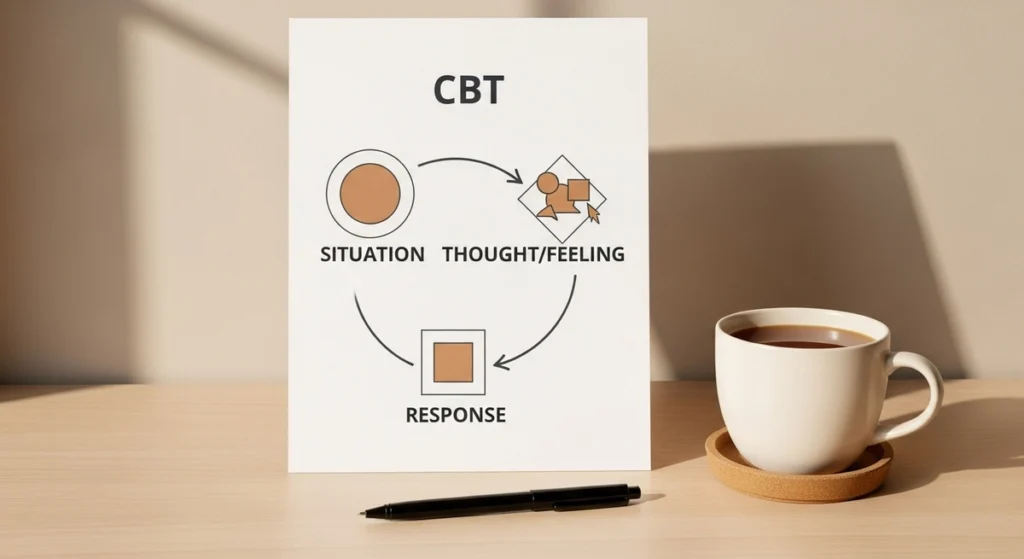
How does CBT change the brain?
Cognitive Behavioral Therapy (CBT) is an evidence-based psychotherapy focusing on identifying and modifying unhelpful thought patterns and behaviors. Functional MRI studies show CBT increases prefrontal cortex activity while reducing amygdala reactivity, improving emotional regulation.
A 2020 randomized controlled trial in The Lancet Psychiatry involving over 1,700 participants found CBT significantly reduced anxiety severity compared to usual care.
What is the ABC model in CBT?
The ABC model separates:
- A Antecedent: The situation.
- B Belief: The interpretation.
- C Consequence: Emotional and behavioral response.
Distress arises from beliefs, not events. Writing ABC records trains the brain to pause before reacting.
How does cognitive restructuring work?
Cognitive restructuring evaluates thoughts as hypotheses, not facts. Evidence for and against the thought is reviewed. Balanced alternatives replace extreme conclusions. This process reduces emotional intensity and improves decision-making.
Daily Practices That Build Positive Mental Energy

How long should you practice mental rewiring techniques?
Clinical trials suggest daily practice of 10 to 20 minutes produces measurable benefits within 4 to 8 weeks. Consistency matters more than duration.
What is scheduled worry time?
Scheduled worry time assigns a specific daily period, usually 15 to 20 minutes, for worrying. Outside this window, worries are postponed. Research from anxiety treatment protocols shows this technique reduces overall rumination frequency and improves sleep quality.
Does behavioral activation improve mood?
Yes. Behavioral activation focuses on action before motivation. A 2019 meta-analysis in Clinical Psychology Review found behavioral activation as effective as CBT for depression in many cases. Completing planned activities increases dopamine signaling and self-efficacy.
How does habit stacking help mental health?
Habit stacking links new practices to existing routines, such as reframing thoughts while brushing teeth. This reduces reliance on motivation and improves adherence, which research shows is critical for neuroplastic change.
Gratitude and Realistic Optimism
Can gratitude change brain function?
Yes. A 2021 systematic review in Frontiers in Psychology found gratitude interventions improved emotional regulation and sleep quality. Functional brain changes were observed in reward-related regions, though structural changes require long-term practice.
What is realistic optimism?
Realistic optimism acknowledges difficulty while maintaining confidence in coping ability. It differs from toxic positivity, which suppresses valid emotions. Mental health professionals emphasize validation plus problem-solving for long-term resilience.
Is gratitude safe for everyone?
Gratitude practices are generally safe. People with unresolved trauma may experience emotional discomfort. In such cases, professional guidance is recommended.
Lifestyle Factors That Support Brain Rewiring
Does exercise affect mental health?
Yes. Physical activity increases brain-derived neurotrophic factor (BDNF), supporting neural growth. According to a 2022 JAMA Internal Medicine study, 150 minutes of moderate exercise weekly reduced depression risk by 26 percent.
How does sleep influence negative thinking?
Sleep deprivation impairs prefrontal regulation, increasing emotional reactivity. The American Academy of Sleep Medicine recommends 7 to 9 hours of sleep for adults to support emotional and cognitive health.
Do social relationships matter?
Strong social support buffers stress. Longitudinal studies from Harvard indicate social connection predicts long-term mental and physical health better than many lifestyle factors.
Common Challenges and Evidence-Based Solutions
Problem: Techniques feel ineffective initially Solution: Neuroplastic change requires repetition. Clinical trials show measurable changes after several weeks, not days.
Problem: Increased awareness increases distress Solution: Pair awareness with grounding. Mindfulness-based CBT reduces reactivity over time.
Problem: Difficulty staying consistent Solution: Reduce practice duration. Research shows shorter daily sessions outperform inconsistent longer sessions.
When to Seek Professional Help
Seek professional evaluation if negative thoughts are persistent, intrusive, or linked to functional impairment. Immediate help is needed for suicidal thoughts, severe depression, or panic symptoms. In the United States, contact the 988 Suicide and Crisis Lifeline for urgent support.
Frequently Asked Questions
Can negative thinking be a symptom of a mental disorder?
Yes. Persistent negative thinking may occur in anxiety disorders, major depressive disorder, and trauma-related conditions. Diagnosis requires evaluation by a licensed mental health professional using DSM-5-TR criteria.
How long does it take to rewire negative thoughts?
Early improvements often appear within 4 to 8 weeks of consistent practice. Deeper habit change may take several months depending on stress levels and support systems.
Is CBT better than medication?
CBT and medication address mental health differently. Research shows similar effectiveness for mild to moderate anxiety and depression. Combined treatment may be recommended in some cases.
Can mindfulness replace CBT?
Mindfulness supports awareness but does not directly challenge distorted thoughts. CBT remains the gold standard for structured cognitive change.
Are these techniques safe during pregnancy?
Mental practices like CBT techniques and mindfulness are generally safe. Always consult a healthcare provider for mental health concerns during pregnancy.
Do supplements help rewire thoughts?
No supplement has strong evidence to rewire thinking alone. Supplements should not replace therapy and require medical consultation.
What if negative thoughts return?
Relapse is common. Maintenance practice reduces recurrence. CBT teaches skills rather than eliminating thoughts permanently.
Can children use these techniques?
Yes, age-appropriate CBT is effective in children and adolescents when delivered by trained professionals.
Does journaling help?
Structured journaling, such as CBT thought records, improves emotional regulation according to multiple clinical trials.
When should results be noticeable?
Improved emotional awareness may appear early. Reduced reactivity and improved mood typically develop over weeks.
Medical Disclaimer
This information is for educational purposes only and does not substitute professional medical or mental health advice, diagnosis, or treatment. If you experience persistent distress, consult a qualified healthcare provider or licensed mental health professional for personalized care.
Conclusion
Clinical evidence confirms that structured cognitive practices can reduce negative thinking patterns by strengthening prefrontal regulation and emotional resilience. Begin with one consistent, manageable technique and track progress over weeks. Mental health improves with practice, patience, and professional support when needed.