

Why Overthinking Is a Habit Not a Personality Trait. Discover why rumination is a learned habit, the neuroscience behind mental loops, and how to rewire your brain. You know that feeling when you replay a conversation at two in the morning, picking apart every word? You’re convinced this mental spiral defines who you are, an unchangeable character flaw. Here’s the truth: overthinking isn’t part of your personality. It’s a mental habit your nervous system learned, and you can change it.
Medical Disclaimer:
This content is for informational purposes only and does not constitute medical advice. Consult a qualified healthcare provider before starting any new health program, supplement, or treatment, especially if you have existing medical conditions.
Is overthinking a personality trait or a habit?
Overthinking is a learned behavioral habit, not a fixed personality trait. While personality remains stable throughout life, rumination represents repetitive, negative, passive dwelling on experiences. Your brain forms these patterns through repeated neural activation, making rumination feel automatic. Research shows this distinction unlocks neuroplasticity’s power, letting you reshape how your brain responds to stress and uncertainty. Understanding this difference gives you back control.
Personality vs. Behavior: Why the Distinction Matters
What Defines Personality?
Personality includes stable patterns in how you think, feel, and behave across situations and throughout life. These patterns reflect genetic predisposition mixed with early environmental influences. Traits like introversion, conscientiousness, or openness stay relatively consistent over time. Your personality can shift gradually during major life transitions, but core characteristics tend to persist. This stability helps others predict your responses and shapes your sense of identity.
What Defines a Habit or Behavior?
Behavior represents your response to stimuli in specific moments. Unlike personality, behaviors adapt quickly and respond to environmental or internal state changes. You can modify behaviors through conscious effort, new learning, and shifting circumstances. When you practice a behavior repeatedly, your brain creates neural pathways making the response increasingly automatic. These pathways form through a process where neurons activating together strengthen their connections, eventually requiring less conscious effort.
The Overthinking Trap
Overthinking falls into unconscious behavior territory, an automatic response pattern your brain defaults to under pressure. Because it activates without conscious thought, you mistake this mental habit for permanent personality. The pattern feels so ingrained you say things like “I’m just a natural worrier” or “that’s who I am.” This misidentification matters. Viewing overthinking as unchangeable personality removes your agency. When you recognize rumination as learned behavior, you regain power to intervene and create new patterns.
You may also like: Why Time management fails most working moms Today? Best Effective Solutions in 2026
The Science of the Mental Loop: How Rumination Becomes a Habit
The Habit-Goal Framework
Rumination often starts when you analyze why a goal wasn’t met or why a situation didn’t unfold as expected. Your brain naturally seeks to understand discrepancies between what you wanted and what happened. When these analytical thoughts occur repeatedly during negative moods, the brain creates a stimulus-response mechanism. Over time, negative mood itself triggers rumination, regardless of whether the original problem still exists. Your brain learns “feeling bad equals time to think in circles.”
Your Brain’s Neural Highways
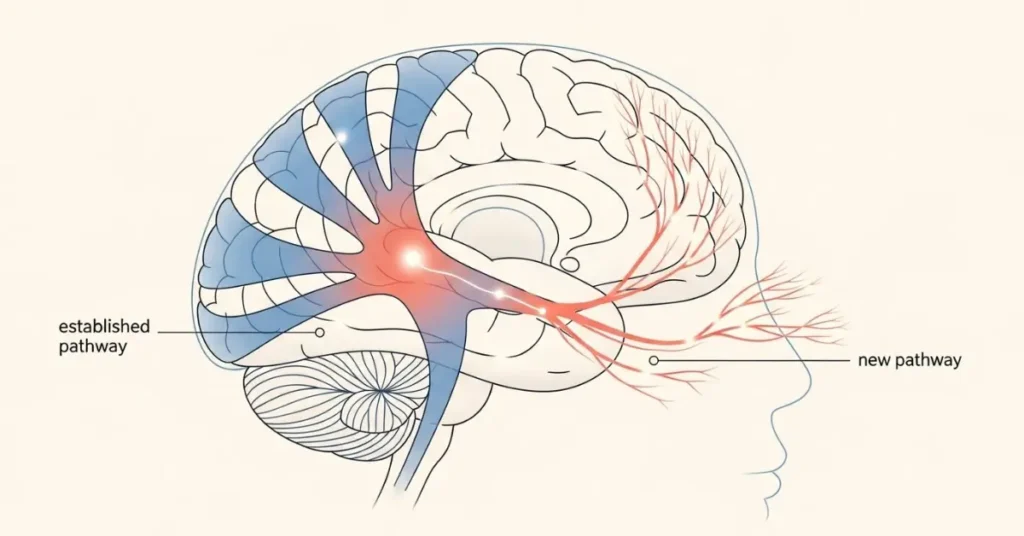
Think of your brain as a city with well-traveled roads where thoughts naturally follow frequently used paths. This network of preferred routes is called the Default Mode Network. The more you ruminate, the wider that neural pathway becomes. Hebbian learning demonstrates that neurons firing together wire together. Each time you engage in overthinking, you strengthen these connections. The ruminative loop becomes the path of least resistance. Your brain sculpts itself around patterns you practice most.
The Neuroscience of Thought Suppression
Trying to stop overthinking often backfires spectacularly. When you suppress a thought, your brain must continuously check whether you’re thinking about that forbidden topic. This monitoring keeps the thought active in your awareness. Research on thought suppression reveals a counterintuitive finding: the harder you push a thought away, the more persistent it becomes. Suppression creates a rebound effect where unwanted thoughts return with greater intensity than before you tried controlling them.
Why Overthinking Is Actually a Safety Mechanism
The Threat Detection Network
Your brain evolved to keep you alive by scanning for potential threats. Overthinking represents your brain’s attempt to predict outcomes and prepare for danger. The challenge? Your threat detection system can’t distinguish between actual physical danger and a vividly imagined social mistake from last week. Both situations activate similar neural pathways associated with threat response. Your brain treats the embarrassing moment you replayed fifty times with the same seriousness as genuine survival threat.
The Illusion of Productivity
Overthinking often develops because at some point, it appeared to work. Maybe excessive analysis helped you avoid a mistake, prepared you for a difficult conversation, or made you feel more in control during uncertainty. This reinforcement creates learned vigilance, where your brain associates constant thinking with safety and preparation. The pattern persists even when exhausting because your brain remembers times rumination seemed helpful. Thinking feels safer than acting, creating a mental comfort zone that’s actually uncomfortable.
When Safety Becomes Suffering
The protective intention behind overthinking doesn’t make it beneficial. While your brain tries keeping you safe through constant analysis, this strategy often increases anxiety and decreases actual problem-solving ability. Rumination that once felt protective becomes a trap. Your nervous system remains in heightened alert, scanning for threats existing primarily in imagination. This chronic activation exhausts mental resources and interferes with concrete actions that could actually address concerns.
Please Read: How to Practice Mindfulness Without Silence Sitting or Spirituality in 2026
Overthinking vs. Problem-Solving: Knowing the Difference
The Brainstorming Phase
Productive problem-solving focuses on issues within your control and generates potential solutions. You identify the specific problem, consider multiple approaches, evaluate options based on available information, and create an action plan. This process moves forward toward resolution rather than circling around the same territory. Effective problem-solving has a beginning, middle, and end. You gather information, make decisions, and implement solutions. The thinking serves clear purpose and produces tangible outcomes.
The Ruminative Loop
Overthinking involves replaying the same scenario without reaching new insights. You review past events that can’t be changed, worry about future outcomes you can’t control, and focus predominantly on negative interpretations. The pattern is characterized by repetitive negative thinking shifting attention from the present moment. Unlike productive analysis, rumination doesn’t generate action plans or move toward resolution. You think in circles, returning to the same starting point repeatedly. The process feels consuming but produces no forward movement.
Recognizing Your Pattern
You can identify overthinking by noticing whether mental activity leads anywhere productive. Ask yourself whether you’re generating new perspectives or rehashing familiar territory. Productive thinking feels active and engaging. Rumination feels passive and draining. Problem-solving creates energy and motivation for action. Overthinking depletes energy and creates paralysis. If you’ve been thinking about something for hours without forming concrete next steps, you’ve likely crossed from productive analysis into rumination territory.
The Neuroscience of Breaking the Habit: RFCBT and Neuroplasticity

Why “Just Stop Thinking” Backfires
Commanding yourself to stop overthinking paradoxically increases rumination. Thought suppression amplifies thought intensity because the brain must constantly monitor whether you’re thinking the forbidden thought. This monitoring keeps the thought active in working memory. The process resembles trying to smooth water by pressing on it. Your intervention creates more disturbance. Your brain needs a different approach, one that redirects rather than suppresses and replaces unproductive patterns with constructive alternatives.
Rumination-Focused Cognitive Behavioral Therapy
RFCBT differs from standard CBT by focusing on the process of thinking rather than content of thoughts. Traditional cognitive therapy challenges whether thoughts are true or accurate. RFCBT addresses how you think, not just what you think. This approach uses functional analysis to identify triggers activating your ruminative habit. You learn recognizing contexts and emotional states preceding overthinking episodes. The goal shifts from abstract, evaluative thinking to concrete, action-oriented processing that moves you toward engagement.
Evidence for RFCBT Effectiveness
A 2024 systematic review analyzing 12 studies found preliminary evidence that RFCBT could eliminate depressive symptoms post-intervention and prevent depression relapse. The research included ten randomized controlled trials demonstrating significant benefits. One clinical trial showed RFCBT led to a 65 percent reduction in depressive symptoms and a 30 percent reduction in both rumination and negative affect. These improvements were maintained through six-month follow-up periods. Brain imaging studies revealed RFCBT reduces cross-network connectivity associated with rumination.
Rewiring through Neuroplasticity
Neuroplasticity refers to the brain’s ability to reorganize and rewire neural connections, enabling it to adapt and function differently from its prior state. This capacity persists throughout your entire life, not just childhood. Small daily changes accumulate to sculpt your brain into a better version of itself. When you practice new thought patterns consistently, you create and strengthen alternative neural pathways. Old ruminative highways don’t disappear immediately, but they receive less traffic and gradually become less dominant.
The Timeline for Change
Research shows plasticity continues throughout the lifespan, supporting learning, memory, and recovery from injury or disease. Individual experiences vary, but most people notice initial changes in rumination patterns within four to eight weeks of consistent practice. The key lies in regular engagement with new strategies rather than perfection. Your brain responds to repeated practice, even when that practice feels awkward initially. Neural pathways strengthen with each repetition, making healthier thought patterns progressively more automatic.
Readers also like: Daily Habits and Daily Routines for Sustainable Focus and Discipline
Practical Strategies to Reset Your Nervous System
The 3-3-3 Reset
When you notice yourself spiraling into overthinking, engage your immediate environment. Identify three specific things you can see, describing them in detail. Notice three distinct sounds you hear, whether a clock ticking, distant traffic, or your own breathing. Move three parts of your body deliberately, perhaps wiggling your toes, rolling your shoulders, and stretching your fingers. This practice interrupts the ruminative loop by redirecting attention from internal worries to external sensory input.
Externalizing the Loop
Write your repetitive thoughts exactly as they appear in your mind, without editing or organizing them. The physical act of writing removes these thoughts from your working memory and reduces cognitive load. You don’t need to analyze or solve the thoughts. Simply transcribe them onto paper or screen. This externalization creates distance between you and the rumination, allowing objective observation of patterns. Many people discover their overthinking follows predictable scripts once they see thoughts written out.
Scheduling a Thinking Container
Instead of banning overthinking entirely, set a specific fifteen-minute window earlier in your day for designated worry time. When ruminative thoughts arise outside this window, acknowledge them and remind yourself you have scheduled time to address them. During your designated period, engage fully with whatever concerns arise. This strategy works because it respects your brain’s tendency to ruminate while containing it within boundaries. Your mind can relax knowing it will have dedicated time.
Physical Grounding
Use slow breathing with an extended exhale to activate your parasympathetic nervous system. Breathe in for a count of four, then exhale for a count of six or eight. The longer exhale signals safety to your body’s stress response system. Alternatively, focus attention on physical sensations like your feet on the floor, the weight of your body in your chair, or fabric texture against your skin. These grounding techniques shift your nervous system from fight-or-flight activation to rest-and-digest state.
Behavioral Activation
RFCBT applies functional analysis to reduce avoidance and replace it with adaptive approach behaviors. When overthinking pulls you inward, deliberately engage in concrete activity requiring your attention. This might include organizing a space, completing a simple task, or moving your body. The action breaks the rumination cycle by redirecting mental resources toward present-moment engagement. Choose activities providing clear feedback about your progress, creating accomplishment sense contrasting with unproductive rumination.
Conclusion: From “Broken” to Supported
Overthinking is a physiological habit rooted in your nervous system’s attempt to protect you, not a character defect defining who you are. This distinction transforms your relationship with rumination from helpless frustration to empowered intervention. By treating overthinking as learned behavior, you gain power to identify triggers and form new, constructive thinking habits. Neural pathways currently supporting ruminative patterns can be redirected toward more productive processing through consistent practice.
Your brain learned to overthink because at some point, this pattern appeared to serve you. With understanding and tools drawn from neuroscience, you can teach your brain new responses to stress and uncertainty. You’re not “too much” or fundamentally flawed. You have a brain that learned to stay on high alert as a survival strategy. Through neuroplasticity-based approaches, you can help your nervous system recognize it’s safe to step off that constant vigilance. The journey from overthinking to clearer thinking is possible, one conscious redirection at a time.
Frequently Asked Questions
Can overthinking be a sign of a mental illness?
Rumination can be associated with mental health conditions such as generalized anxiety disorder, depression, and post-traumatic stress disorder. Overthinking itself isn’t a diagnosis but rather a symptom or thinking pattern appearing across various conditions. If rumination significantly impairs your daily functioning, persists despite self-help efforts, or occurs alongside other concerning symptoms, consulting a mental health professional is advisable. They can assess whether your overthinking indicates an underlying condition requiring specialized treatment.
How do I stop overthinking and start living?
Begin by recognizing overthinking as it occurs rather than fighting it directly. Practice redirecting attention to concrete activities in the present moment, using grounding techniques to anchor yourself physically. Schedule specific times for productive problem-solving instead of ruminating continuously. Engage in behavioral activation by choosing meaningful actions aligning with your values, even when your mind generates anxious thoughts. Progress happens gradually through consistent practice, not through perfectly eliminating all repetitive thoughts immediately.
What is the root cause of overthinking?
Overthinking typically develops through a combination of temperament, learned responses, and environmental factors. Some people have naturally higher sensitivity to potential threats. Past experiences where analysis helped avoid problems can reinforce the pattern. Stress, uncertainty, perfectionism, and anxiety can trigger increased rumination. The habit strengthens through neural repetition, creating pathways making overthinking feel automatic. Understanding your specific triggers helps you address the habit more effectively than searching for a single root cause.
Why is my brain always overthinking everything?
Your brain may have learned that constant analysis provides a sense of control or preparedness in uncertain situations. This pattern becomes habitual through repeated neural activation. Your Default Mode Network, which activates during rest, may preferentially engage in ruminative thinking. If you experience high stress, anxiety, or uncertainty, your brain’s threat detection system may remain chronically activated, prompting continuous mental scanning. These neural patterns can change through targeted intervention and practice.
Is overthinking a trauma response?
Overthinking can develop as a response to past trauma, though not everyone who overthinks has experienced trauma. Following traumatic events, some people develop hypervigilance where the brain constantly scans for danger to prevent similar harm. This protective mechanism can manifest as rumination about potential threats. Overthinking also occurs without trauma history through other pathways like learned anxiety responses or temperamental tendencies. If you suspect trauma underlies your rumination, trauma-informed therapy can address both underlying experiences and thinking patterns.
What happens in the brain during rumination?
During rumination, specific brain networks become more active and connected. The Default Mode Network, associated with self-referential thinking, shows increased activation. Neural communication between regions involved in emotion processing and executive control becomes dysregulated. The prefrontal cortex, which typically helps regulate emotions, may show reduced ability to down-regulate negative feelings. These patterns create a feedback loop where thinking about problems increases emotional distress, which then triggers more rumination. Understanding this biological basis helps you approach overthinking as changeable.
How does RFCBT differ from traditional CBT?
Traditional cognitive behavioral therapy primarily focuses on identifying and challenging the content of negative thoughts, asking whether thoughts are accurate or realistic. RFCBT shifts attention to the process of thinking itself, addressing how you think rather than just what you think. It uses functional analysis to identify triggers for rumination and teaches concrete, action-oriented processing to replace abstract, evaluative thinking. RFCBT specifically targets rumination’s habitual nature through behavioral activation and experiential exercises designed to interrupt ruminative cycles.
Can you actually rewire your brain to stop overthinking?
Yes, through neuroplasticity, your brain can form new neural pathways and weaken old ruminative patterns. This process requires consistent practice of alternative responses when overthinking urges arise. Research demonstrates measurable changes in brain connectivity following rumination-focused interventions. Rewiring happens gradually as you repeatedly choose different responses to stress and uncertainty. New patterns feel effortful initially but become more automatic with practice. While you may not eliminate all rumination, you can significantly reduce its frequency, intensity, and duration through sustained effort.
Why is overthinking worse at night?
Several factors contribute to increased rumination at night. Reduced external stimulation removes distractions that might otherwise occupy your attention during daytime. Fatigue depletes mental resources needed to regulate thoughts effectively. Lying in bed provides few competing demands for your attention, allowing your mind to wander freely. Darkness and quiet can trigger your brain’s threat detection system to become more active, scanning for potential dangers. Establishing a wind-down routine, limiting screen time before bed, and using relaxation techniques can help interrupt nighttime rumination.
How long does it take to break the overthinking habit?
Individual timelines vary based on factors including how long the pattern has existed, consistency of practice, and individual neuroplasticity. Most people notice initial improvements within four to eight weeks of regular practice using evidence-based techniques. Significant reduction in rumination typically occurs over three to six months. Breaking a deeply ingrained habit is ongoing rather than a one-time achievement. You may experience periods of improvement followed by temporary setbacks, which are normal parts of the change process. Sustained practice yields lasting results.