

Motherhood often places sustained demands on attention, patience, and emotional energy, especially for women balancing paid work, caregiving, and household responsibilities. Over time, these pressures can lead to mental crowding, emotional fatigue, and a quiet sense of disconnection from oneself. Journaling prompts for overwhelmed moms are commonly used as a reflective lifestyle practice that supports clarity and emotional steadiness without making therapeutic or medical claims.
In everyday family life, overwhelm usually builds gradually rather than appearing suddenly. Noise, constant decision making, and emotional responsibility can accumulate until even small tasks feel heavy. Writing provides a private, structured way to notice these experiences, helping many mothers feel more grounded and mentally organized.
Journaling in this context is not framed as treatment or self improvement. It is presented as a practical habit that encourages awareness and reflection. The value lies in creating space to observe thoughts and emotions, not in fixing or analyzing them.
Understanding Emotional Overload in Modern Motherhood

Emotional overload in motherhood is often linked to constant multitasking and sustained emotional availability. Many mothers move through their days switching rapidly between roles, managing children’s needs, work expectations, and household logistics. This ongoing adjustment can quietly drain emotional reserves and reduce the sense of internal calm.
Overwhelm is commonly described as the point where personal capacity feels smaller than daily demands. This experience does not reflect poor coping or lack of resilience. Lifestyle research and parenting studies often describe it as a predictable response to long term cognitive and emotional strain.
Recognizing emotional overload as situational rather than personal can ease self criticism. Journaling prompts for overwhelmed moms are frequently used to create a neutral space for this recognition. Writing allows experiences to be acknowledged without pressure to justify or resolve them.
Journaling Prompts for Overwhelmed Moms as a Lifestyle Practice
Journaling prompts for overwhelmed moms are short statements or questions that guide reflective writing. They remove the burden of deciding what to write and help keep reflection focused and contained. In daily use, prompts act as gentle starting points rather than tasks that must be completed thoroughly.
This structure can feel supportive for mothers who already carry heavy mental loads. Open ended journaling sometimes adds pressure, while prompts narrow attention to one idea at a time. That focus often makes writing feel more manageable.
Lifestyle guidance generally emphasizes consistency over depth. Writing briefly and regularly is commonly viewed as more sustainable than long, infrequent sessions. Journaling prompts support this approach by fitting easily into real family routines.
Expressive Writing and Everyday Emotional Processing
Expressive writing involves putting thoughts and feelings into words. Research in behavioral health settings has explored how this process supports emotional awareness and mental organization. In everyday life, expressive writing is often used simply to make internal experiences clearer.
For overwhelmed mothers, writing can serve as a private outlet that does not require explanation or reassurance. Thoughts that remain unspoken tend to loop internally, increasing mental fatigue. Writing externalizes these thoughts, which many people find calming.
This practice is self directed and flexible. There is no expectation to analyze emotions or reach conclusions. Journaling prompts provide a structure for noticing what is present, allowing reflection to stay supportive rather than demanding.
Cognitive Clarity Through Structured Reflection
Mental overload often feels like many competing thoughts all asking for attention at once. Structured journaling helps organize these thoughts by placing them on the page. This simple act can reduce the sense of internal noise.
When concerns are written down, they often feel less urgent and less overwhelming. This does not remove problems, but it can make them feel more manageable. Lifestyle educators sometimes describe this as creating mental breathing room.
For mothers managing many responsibilities, clearer thinking supports calmer decisions. Journaling prompts for overwhelmed moms are often used during transitions, such as early mornings or quiet evenings. These brief pauses allow reflection without adding new demands.
Time Constraints and Realistic Writing Habits
Limited time is one of the most common reasons mothers avoid journaling. Wellness educators often suggest reframing journaling as a short habit rather than a lengthy activity. Writing for three to five minutes is generally considered enough to support reflection.
Micro journaling focuses on brief entries, such as a few sentences or a short list. This approach reduces pressure and makes the habit easier to maintain. Prompts are especially useful here because they limit the scope of writing.
In daily routines, journaling can be paired with existing pauses, such as having tea or preparing for bed. The practice does not require ideal conditions or extended silence. Flexibility supports long term consistency.
Shared Spaces and Writing Without Privacy
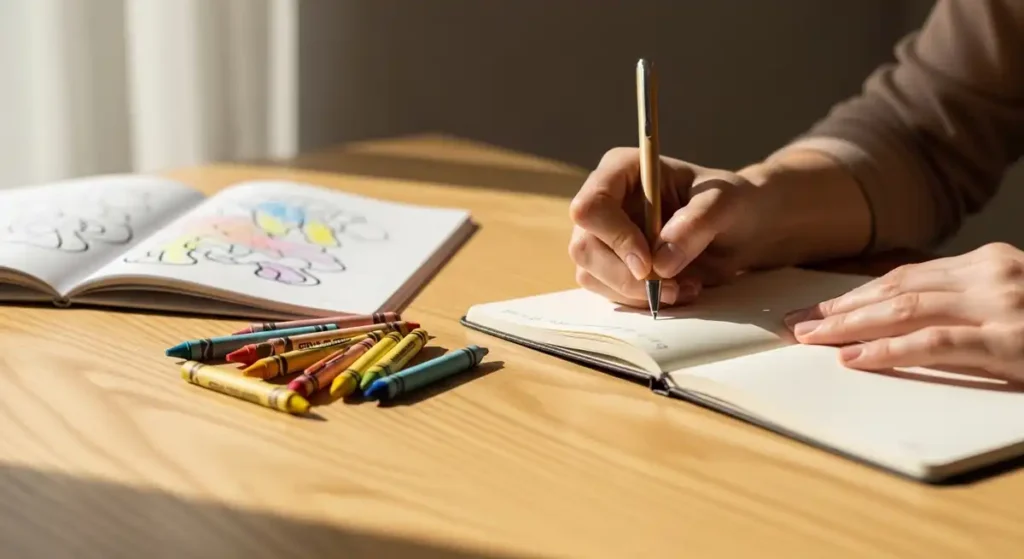
Many mothers live in shared homes where privacy is limited. Journaling in these settings may involve writing briefly, using neutral language, or choosing digital formats. Lifestyle guidance encourages adapting practices rather than abandoning them.
Some mothers write while children are nearby, engaged in their own activities. Others prefer short notes or lists that feel discreet. The effectiveness of journaling does not depend on complete privacy, but on personal relevance.
Journaling prompts for overwhelmed moms are designed to work in imperfect conditions. Even fragmented or occasional writing can support awareness. The goal is reflection, not ideal practice.
Cognitive Behavioral Inspired Reflection Without Therapy Claims
Some journaling prompts draw inspiration from cognitive behavioral ideas, such as noticing thought patterns. In lifestyle contexts, these prompts are used for observation rather than treatment. They encourage curiosity about thoughts without labeling them as right or wrong.
Writing about a stressful thought can create distance between the thought and personal identity. This distance often reduces emotional intensity. Many people find it easier to respond calmly after seeing thoughts written down.
It is important to note that this form of journaling does not replace professional care. It is presented as a supportive habit that may complement other forms of support. Prompts are used gently and voluntarily.
Reframing Self Talk Through Writing
Periods of overload often bring harsher internal dialogue. Journaling provides a way to notice this tone and introduce more balanced language. Writing prompts that encourage kindness or neutrality can support steadier emotions.
This does not involve forced positivity or denying difficulty. Instead, it allows acknowledgment alongside self respect. Many people find that writing softens extreme self judgments naturally.
Over time, reframing self talk through journaling may reduce emotional reactivity. The practice supports patience with oneself during demanding seasons. It remains supportive rather than corrective.
Sensory Overstimulation and Emotional Awareness
Sensory overstimulation is a common experience for mothers managing noise, movement, and constant interaction. Journaling can help identify specific triggers that contribute to irritability or fatigue. Writing creates a record that reveals patterns over time.
By noting physical sensations along with emotions, journaling supports body awareness. This awareness helps many people notice early signs of overload. Lifestyle guidance frames this as observation rather than problem solving.
Journaling prompts for overwhelmed moms may include reflection on environment or energy levels. These prompts encourage noticing without blame. Awareness itself is considered the main benefit.
Supporting Emotional Regulation Through Reflection
Emotional regulation involves recognizing feelings and responding thoughtfully rather than reactively. Journaling supports this by slowing internal responses. Writing introduces a pause between experience and reaction.
This pause allows emotions to be acknowledged instead of suppressed. Many people report feeling calmer after writing, even when circumstances remain the same. Expression, not resolution, is the focus.
For mothers, emotional regulation supports steadier interactions with family members. Journaling prompts provide a consistent method for private emotional processing. Over time, this consistency may feel stabilizing.
Identity Awareness Beyond Caregiving Roles
Many mothers notice that personal identity can narrow as caregiving demands increase. Journaling can support reconnection with values, interests, and qualities beyond parenting roles. This reflection is often gentle and exploratory.
Writing about personal traits or past interests does not require immediate action. Awareness alone can feel grounding. Lifestyle educators emphasize that noticing identity shifts is meaningful in itself.
Journaling prompts for overwhelmed moms may focus on non parental aspects of self. These reflections help maintain a sense of individuality during demanding life stages. This awareness supports emotional balance.
Personal Meaning and Everyday Fulfillment
Meaning in daily life is often found in small moments rather than major achievements. Journaling supports recognition of these moments by bringing attention to what feels sustaining. Writing helps preserve these experiences mentally.
Reflecting on meaning can counter feelings of monotony or emotional flatness. This does not imply constant positivity, but balanced awareness. Wellness guidance treats meaning as personal and changeable.
For mothers, journaling offers space to notice fulfillment alongside responsibility. This balanced reflection supports resilience during busy periods. The practice remains flexible.
Boundaries and Energy Awareness
Boundaries are often discussed as limits that protect time and energy. Journaling can support boundary awareness by clarifying what feels draining or supportive. Writing reveals patterns that may otherwise go unnoticed.
This awareness does not require immediate change. Noticing patterns is considered a useful first step. Journaling prompts encourage reflection without pressure to act.
Over time, energy awareness may inform small adjustments in routines. Journaling supports thoughtful consideration rather than reactive decisions. This gradual approach aligns with sustainable lifestyle guidance.
Understanding and Softening Guilt
Guilt is a frequent experience for mothers who feel pulled in many directions. Journaling offers a space to examine guilt without reinforcing it. Writing allows feelings to exist without justification.
Wellness educators often describe guilt as information rather than instruction. Journaling helps separate personal values from unrealistic expectations. This separation may reduce emotional intensity.
Journaling prompts for overwhelmed moms may include reflections on effort or intention. These prompts support emotional balance without self evaluation. The tone remains neutral and respectful.
Sustainable Self Care Framing
Self care in lifestyle education is often framed as maintenance rather than indulgence. Journaling fits this view as a low effort, low cost practice. It supports ongoing awareness rather than escape.
This framing avoids presenting self care as another task. Journaling is optional and adaptable. Missing days does not negate its value.
For mothers, sustainable self care emphasizes realism. Journaling prompts support this by simplifying the process. The practice remains accessible across life stages.
Integrating Journaling Into Daily Routines
Routine integration supports habit consistency. Journaling can be paired with existing behaviors, such as morning tea or bedtime routines. This pairing reduces the effort of starting.
Wellness guidance suggests that timing matters less than consistency. Morning or evening writing can both work. Choosing a moment that feels least disruptive supports sustainability.
Journaling prompts for overwhelmed moms simplify routine integration. With prompts available, writing becomes predictable. Predictability supports long term use.
Non Therapeutic Framing and Safety
Journaling is not a substitute for professional mental health care. It is framed as supportive, not corrective or curative. This distinction is important for emotional safety.
If writing brings up distress that feels unmanageable, pausing is appropriate. Professional support may be helpful in those situations. Journaling should feel containing rather than overwhelming.
Responsible wellness content avoids promising outcomes or timelines. Benefits vary by person and context. Journaling remains voluntary and self directed.
FAQs
What should mothers typically write about when using journaling prompts
Mothers often write about daily experiences, emotions, or thoughts that feel persistent. Journaling prompts for overwhelmed moms offer direction without requiring depth or analysis. Writing focuses on awareness and expression rather than problem solving.
How journaling is commonly associated with stress awareness
Journaling is commonly linked with noticing stress patterns rather than removing stress. Writing helps people recognize triggers, reactions, and energy shifts. This awareness supports informed adjustments in daily routines.
Whether journaling requires long uninterrupted time
Journaling does not require long uninterrupted time to be useful. Many people write briefly in shared or busy environments. Short, consistent entries are widely considered enough.
If journaling can feel emotionally uncomfortable at times
Journaling can sometimes bring attention to uncomfortable emotions. This response is often temporary. Pausing or adjusting the practice is appropriate if discomfort increases.
How often journaling is typically practiced
Journaling frequency varies by preference and schedule. Some people write daily, others weekly. Consistency is encouraged, but flexibility is emphasized.
Whether digital journaling is acceptable
Digital journaling is commonly accepted and accessible. Format does not determine effectiveness. Choosing what feels easiest supports regular use.
How journaling fits into parenting responsibilities
Journaling fits into parenting life by being brief and adaptable. It does not require separation from family routines. Many mothers integrate writing without disruption.
If journaling replaces other wellness practices
Journaling does not replace other wellness practices. It is often used alongside rest, movement, or social support. Each practice serves a different role.
When professional support may be appropriate
Professional support may be appropriate if distress feels persistent or overwhelming. Journaling is not designed for clinical concerns. Seeking qualified help is responsible.
Whether journaling outcomes are guaranteed
Journaling outcomes are not guaranteed and vary between individuals. It is offered as a supportive option rather than a solution. Benefits depend on personal context.
Editorial Conclusion
Journaling prompts for overwhelmed moms are commonly used as a practical way to support emotional awareness and mental clarity. The practice adapts to everyday routines and changing demands without requiring ideal conditions. When framed responsibly, journaling remains a supportive lifestyle habit that encourages steadiness and self understanding over time.
Medical Disclaimer
This content is for informational purposes only and does not constitute medical or mental health advice. It is not intended to diagnose, treat, cure, or prevent any condition. Always consult a qualified healthcare or mental health professional regarding personal health concerns.
For wider background on this, see the American Psychological Association on mindfulness.
Related Reading
- How to Create a Safe Space for Emotional Release
- Forest Bathing Guide for Beginners: The Science and Practice of Shinrin-yoku
- 5 Minute Mindfulness for Overwhelmed Parents: Simple, Proven Calm
If you want the versions of these that do not involve writing, How to Stop Overthinking sorts them by whether you are replaying the past or rehearsing the future.