

How to Forgive Without Losing Boundaries? Forgiveness is often described as a moral expectation rather than a personal decision, which can quietly create pressure and confusion. Many people are taught that forgiving requires continued access, emotional openness, or silence, even after harm. This framing leaves people carrying unresolved stress while questioning their own judgment and self-respect.
In everyday life, forgiving can feel necessary for peace, yet reconnecting may feel unsafe or exhausting. Parents, caregivers, and working professionals often stay stuck between resentment and obligation, unsure how to move forward responsibly. A more realistic approach separates emotional release from ongoing access, allowing forgiveness without self-erasure.
This article explains forgiveness as an internal process supported by clear boundaries. It presents forgiveness and limits as cooperative tools rather than opposing forces. The focus remains practical, emotionally responsible, and grounded in everyday situations rather than idealized outcomes.
How to Forgive Without Losing Boundaries: Redefining Forgiveness as an Internal Process

Forgiveness is frequently misunderstood as forgetting, but memory exists to support safety rather than resentment. Remembering harmful experiences helps people recognize patterns and make informed decisions. Forgiveness reduces emotional charge tied to memory, allowing calmer responses without erasing awareness.
In daily routines, forgiving often means choosing not to replay the same emotional reactions repeatedly. The event is acknowledged, but it no longer dictates mood, energy, or behavior. This shift supports emotional regulation and reduces stress accumulation over time.
Wellness educators often describe forgiveness as an internal boundary that limits how much space past harm occupies. It protects attention and emotional resources. This perspective allows people to forgive without denying what happened or minimizing its impact.
Forgiveness is also confused with excusing behavior, which creates resistance and mistrust. Excusing suggests justification, while forgiveness simply releases the emotional burden associated with the event. The behavior remains unacceptable, but the emotional cost no longer compounds.
Many people excuse harm to preserve peace, especially within families or workplaces. Over time, this leads to resentment and emotional withdrawal. Separating forgiveness from excusing allows accountability to coexist with emotional relief.
Forgiving does not require changing one’s assessment of what occurred. It allows forward movement without rewriting history. This clarity supports boundaries rooted in reality rather than guilt or obligation.
Forgiveness is not the same as reconciliation, which requires participation and consistency from all involved. Reconciliation depends on accountability, repair, and changed behavior. Forgiveness can occur independently, without renewed closeness.
Social expectations often pressure people to reconcile quickly. When reconciliation happens without safety, emotional harm often repeats. Understanding forgiveness as unilateral reduces this pressure and supports thoughtful decision making.
In practical life, forgiveness may exist alongside limited contact or complete disengagement. These choices reflect discernment rather than bitterness. Forgiveness remains an internal choice focused on emotional freedom.
You may also interested in:
Journaling Prompts for Emotional Healing as a Supportive Lifestyle Practice
Vision Journaling: Designing the Life You Want
Nature Journaling for Powerful Mindfulness and Outdoor Presence
Safety as the Foundation of Forgiveness
Emotional and physical safety are essential before forgiveness can occur naturally. When a person feels threatened or exposed, the nervous system prioritizes protection over reflection. Forgiveness becomes inaccessible under constant stress.
Actual safety refers to reduced risk of harm, while felt safety reflects internal calm. Both matter equally. Without them, attempts at forgiveness often result in suppression rather than genuine release.
In everyday contexts, safety may involve distance, predictability, or support from trusted people. These adjustments stabilize emotional responses. Stability creates space for thoughtful processing.
Premature forgiveness often arises from social pressure. People forgive outwardly to appear mature while remaining internally distressed. This pattern increases emotional strain rather than resolving it.
When forgiveness precedes safety, emotional activation often repeats. This can reinforce helplessness instead of relief. Delaying forgiveness until stability is present protects self-trust.
Lifestyle guidance emphasizes regulation before reflection. Once safety exists, forgiveness becomes more accessible. This sequence supports lasting emotional balance.
Assessing safety involves observing current behavior patterns rather than promises. Consistency and respect for limits matter more than apologies. Actions signal risk levels more clearly than words.
Physical cues such as tension or vigilance often indicate safety levels. Listening to these signals supports informed decisions. Ignoring them tends to increase internal conflict.
Safety assessment is not about blame. It is about determining conditions that support wellbeing. Forgiveness remains available later without urgency.
Boundaries as a Supportive Structure
Boundaries are often mistaken for punishments, yet they define conditions that keep interaction manageable. They are commitments to oneself rather than controls placed on others. This distinction reduces conflict and guilt.
In everyday life, boundaries protect time, energy, and emotional capacity. Parents and professionals rely on boundaries to prevent burnout. Clear limits support sustainability.
Boundaries create emotional space that lowers reactivity. Reduced exposure to triggering behavior calms the nervous system. Calm supports reflection and emotional release.
Emotional space does not require dramatic separation. It may involve shorter interactions or topic limits. These adjustments reduce strain without severing necessary ties.
Many people feel relief once boundaries are set. Emotional clarity improves as decisions feel less urgent. Forgiveness becomes possible when control over exposure returns.
Boundaries do not attempt to change others. They define personal availability. This clarity reduces power struggles.
By limiting repeated harm, boundaries prevent resentment from accumulating. Forgiveness becomes closure rather than conditional hope. Emotional energy is freed for healthier connections.
Small, consistent boundaries often work better than rigid rules. Gradual adjustments allow adaptation. Stability supports resilience.
Evaluating Relationship Contexts
Different relationships require different boundary responses. History and patterns matter more than isolated incidents. Context supports proportionate decisions.
In trusted relationships with isolated harm, communication may restore balance. Clear expression often resolves misunderstandings. Forgiveness here supports repair.
Repair depends on accountability and consistency. Trust rebuilds gradually through behavior. Forgiveness without change risks repetition.
Chronic violations signal deeper issues. Stronger boundaries protect wellbeing. Patterns predict outcomes more reliably than intentions.
Reduced access or structured interaction often restores stability. Forgiveness may coexist with distance. Emotional release does not require closeness.
In abusive dynamics, safety overrides reconciliation. No contact may be necessary. Distance can support recovery.
Forgiveness may occur internally without communication. Professional support often helps navigate these situations responsibly.
Forgiveness Models as Educational Tools
Forgiveness models offer structure rather than rules. They guide reflection without imposing outcomes. These frameworks are commonly used in educational contexts.
The REACH model frames forgiveness as gradual. It includes recall, perspective, internal offering, commitment, and maintenance. Autonomy remains central.
Recall focuses on accuracy rather than dramatization. This reduces emotional escalation. Clarity replaces rumination.
Perspective taking humanizes context without excusing harm. Emotional intensity often decreases. Accountability remains intact.
Offering forgiveness releases expectation of repayment. Emotional strain lessens. Commitment reinforces the choice privately.
Maintenance accepts emotional fluctuation. Revisiting commitment supports consistency. Progress replaces perfection.
Forgiveness When Interaction Continues
Some situations require ongoing contact. Co-parenting or work demands strategies that reduce strain. Forgiveness focuses on neutrality.
The grey rock approach uses brief, factual responses. Emotional engagement decreases. Escalation reduces.
Neutral interaction conserves energy. Emotional detachment supports stability. Forgiveness develops internally.
This approach suits logistical contexts. Stress often decreases over time.
Forgiveness Without Communication
Forgiveness does not require discussion. Silent forgiveness focuses inward. It suits unsafe or unproductive situations.
Philosophical traditions describe forgiveness as releasing emotional attachment. This prevents ongoing suffering. External conditions remain unchanged.
Practices include journaling or reflection. Closure occurs privately. Boundaries remain intact.
Forgiving Oneself as a Boundary Practice
Self-forgiveness addresses internal blame. Many people fault themselves for not acting sooner. This prolongs distress.
Self-forgiveness acknowledges context and capacity. It reduces harsh judgment. Compassion supports growth.
Mental boundaries limit rumination. Redirecting attention supports balance. Accountability remains present.
Parenting and Working Life Considerations
Parents and professionals face unique pressures. Dependence and time limits complicate boundaries. Practical approaches matter.
Forgiveness often prioritizes stability. Boundaries protect routines. Emotional availability improves.
Workplace forgiveness requires limits. Without boundaries, burnout increases. Clear expectations support sustainability.
Frequently Asked Questions
Is it possible to forgive someone without maintaining contact?
It is possible to forgive without ongoing contact. Forgiveness operates internally and does not require interaction. Many people release resentment while maintaining distance for safety and emotional stability.
Does forgiveness require a relationship to return to its previous state?
Forgiveness does not restore prior dynamics. Relationships often change after harm. Forgiveness supports emotional relief without guaranteeing reconciliation.
Can someone be forgiven without offering an apology?
Forgiveness does not depend on an apology. It focuses on internal release. This approach reduces reliance on others for emotional wellbeing.
How can someone tell forgiveness has occurred?
Forgiveness often shows as reduced emotional reactivity. The memory remains, but its intensity fades. This shift indicates progress.
Is delaying forgiveness a form of self-protection?
Delaying forgiveness can protect wellbeing. Safety supports healthy forgiveness. Timing matters more than speed.
Can boundaries be set after forgiveness?
Boundaries remain necessary regardless of forgiveness. Forgiveness does not remove the need for limits. Boundaries protect emotional health.
Why does forgiveness feel difficult?
Forgiveness is hard when safety is absent. The nervous system prioritizes protection. Addressing safety often helps.
What does forgiving in silence mean?
Forgiving in silence means releasing resentment privately. It avoids unsafe contact. Internal peace remains the focus.
Can relationships function without forgiveness?
Some relationships stabilize through boundaries first. Forgiveness may follow later. Safety comes first.
When is professional support helpful?
Support is helpful when distress increases. Guidance supports clarity and safety. It is useful after repeated harm.
Editorial Conclusion
Forgiveness without boundaries preserves dignity and emotional clarity. It allows release without reopening harm. This balance supports sustainable wellbeing.
Boundaries create conditions for forgiveness rather than forcing it. They protect resources and reinforce self-respect. Forgiveness becomes choice rather than obligation.
Medical Disclaimer
This content is for informational purposes only and does not constitute medical or mental health advice. It does not replace professional care. Consult a qualified healthcare or mental health provider for personal concerns, especially when distress, trauma, or safety issues are present.
Image Prompt 1, Featured Image A photorealistic scene showing a person seated calmly near a window, light filtering through sheer curtains, hands resting gently on their lap. The environment suggests emotional clarity and strength rather than vulnerability. Neutral earth tones, soft blues, and warm natural light convey safety and self-respect. The subject appears thoughtful, not distressed, representing forgiveness with boundaries. Editorial wellness photography, horizontal composition, shallow depth of field, realistic home setting, inclusive appearance, non-model aesthetic, professional magazine quality.
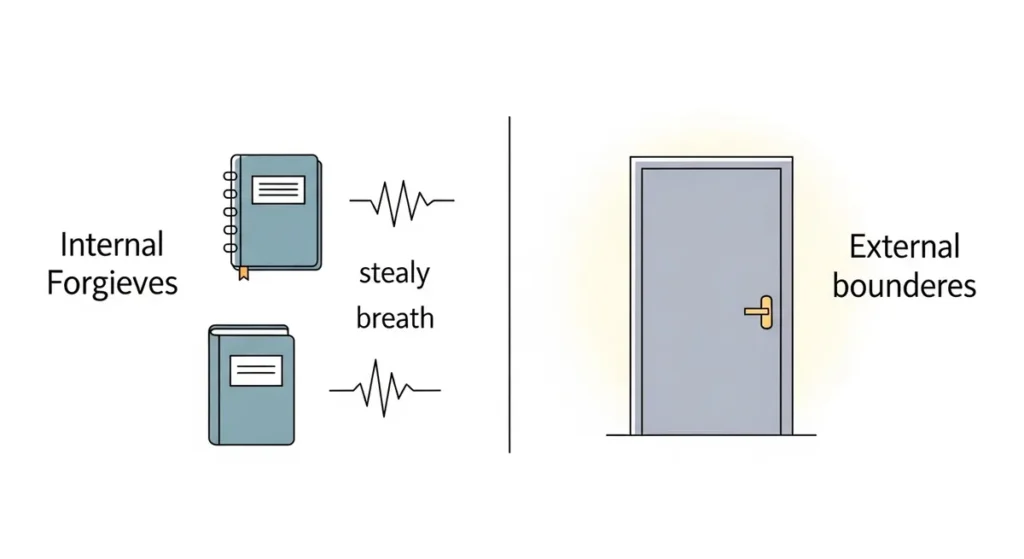
Image Prompt 2, Supporting Concept Image A minimalist illustrated scene showing two distinct zones separated by a subtle line. On one side, calm symbols like a journal and steady breath lines. On the other, a closed door with soft light around it. This visually represents internal forgiveness and external boundaries. Muted color palette, clean lines, instructional clarity, accessible symbolism. Flat illustration style, horizontal orientation, high-resolution, suitable for educational wellness content.
Image Prompt 3, Inspirational Image A diverse adult walking confidently along a quiet natural path at golden hour, shoulders relaxed, posture upright. The environment feels open and safe, symbolizing freedom after forgiveness. Natural greens and warm sunlight dominate. The expression conveys calm resolve, not euphoria. Lifestyle photography, realistic setting, balanced composition, editorial quality, horizontal frame, aspirational yet attainable mood.
Alternative Headline Variations
Variation 1: 7 Science-Backed Ways to Forgive Without Losing Boundaries
Variation 2: Can You Forgive Without Losing Boundaries and Self-Respect?
Variation 3: How to Forgive Without Losing Boundaries or Emotional Safety
Variation 4: Forgive Without Losing Boundaries and Reclaim Emotional Freedom
Variation 5: Science-Backed Guide to Forgive Without Losing Boundaries
Related keywords:
LSI keywords:
Related Reading
- The Balanced Mom Manifesto: A Grounded Framework for Modern Maternal Wellness
- How to Create a Safe Space for Emotional Release
- Mindful Listening: The Key to Better Connections in Everyday Life
This piece covers the principle. For the actual sentences to use when the line gets tested — and what to say the second and third time — see How to Set Boundaries.