
Negative self-criticism and ongoing inner commentary are common experiences shaped by modern work demands, family responsibilities, and constant comparison through media. Many adults notice this pattern during deadlines, parenting decisions, or moments of rest when the mind becomes unusually harsh. Wellness educators describe this as a learned mental habit rather than a personal flaw, shaped by repeated exposure to evaluation and expectation.
Self-criticism rarely appears by choice. It often develops quietly through schooling, social feedback, and cultural messages about achievement and worth. Over time, this internal language becomes automatic and emotionally charged, even when circumstances do not require it. Understanding how to overcome self-criticism and negative talk begins with recognizing this habit without judgment or urgency.
Addressing self-critical thinking does not involve suppressing thoughts or replacing them with forced optimism. Lifestyle guidance focuses on awareness, balance, and safer ways to relate to internal experiences. These approaches support emotional steadiness and clarity while respecting individual differences and the role of professional care when needed.
How to Overcome Self-Criticism and Negative Talk: Understanding the Inner Critic as a Mental Habit
The inner critic is commonly explained in wellness education as a mental habit formed through repetition, not a fixed personality trait. It often reflects earlier experiences of correction, comparison, or high expectations. Because the brain learns through repetition, this internal voice can appear quickly and confidently, even when its message is inaccurate.
This voice often uses absolute language and emotional intensity, which can make its statements feel factual. In reality, it represents learned patterns rather than objective truth. Recognizing the inner critic as a habit allows space for observation instead of immediate belief.
When people begin to see self-criticism as mental activity rather than identity, emotional distance naturally increases. This shift does not remove responsibility or effort. It simply creates room for clearer thinking and calmer responses during everyday challenges.
The Everyday Impact of Negative Self-Talk
Negative self-talk can influence daily functioning in subtle but consistent ways. It often appears during routine tasks such as responding to emails, managing household responsibilities, or reflecting on conversations. Over time, this internal pressure can drain energy and reduce enjoyment of ordinary accomplishments.
Wellness research links persistent self-criticism with increased stress perception and mental fatigue. When the mind constantly evaluates performance, even neutral situations can feel demanding. This does not mean damage is inevitable, but it explains why awareness matters.
Reducing negative self-talk supports focus and emotional balance rather than emotional avoidance. As internal language becomes more measured, people often notice steadier moods and improved concentration. These changes tend to develop gradually through consistent awareness.
Common Patterns in Self-Critical Thinking
One frequent pattern in self-criticism involves constant comparison with others. Digital environments make this habit easy, as people regularly see curated success without context. Comparing internal struggles with external highlights often leads to distorted self-evaluation.
Another common pattern involves harsh judgment after mistakes or delays. Instead of focusing on specific actions, the inner critic may label the entire self as inadequate. Wellness educators note that this reduces learning by shifting attention away from solutions.
A third pattern involves focusing on negatives without problem-solving. This form of mental complaining keeps attention fixed on discomfort without direction. Identifying these patterns early allows calmer, more constructive responses.
Why the Inner Critic Often Feels Protective
Many people are surprised to learn that the inner critic often functions as a perceived safety mechanism. From a stress-awareness perspective, the brain uses criticism to anticipate mistakes and avoid rejection. This explains why self-critical thoughts can feel urgent and convincing.
Protective intent does not mean the method is helpful. Constant internal warnings can keep the nervous system in a heightened state, even during routine activities. Lifestyle guidance encourages acknowledging intent without following the message automatically.
Reframing the critic as overprotective rather than hostile often reduces emotional resistance. This neutral view allows thoughtful response instead of reflexive reaction. Over time, this supports steadier emotional regulation.
Cognitive Distortions That Maintain Self-Criticism
All-or-nothing thinking is a common distortion linked with self-criticism. It frames experiences as complete success or total failure, leaving no room for nuance. This pattern often appears after minor setbacks and intensifies emotional reactions.
Overgeneralization turns isolated events into broad conclusions about identity or ability. A single missed task becomes proof of lasting inadequacy. Wellness education emphasizes separating experiences from identity to reduce unnecessary self-pressure.
Mind reading and negative prediction also play a role. Assuming others hold critical opinions without evidence can amplify anxiety. Recognizing these distortions supports more accurate interpretation of daily interactions.
Learning Cognitive Restructuring Safely
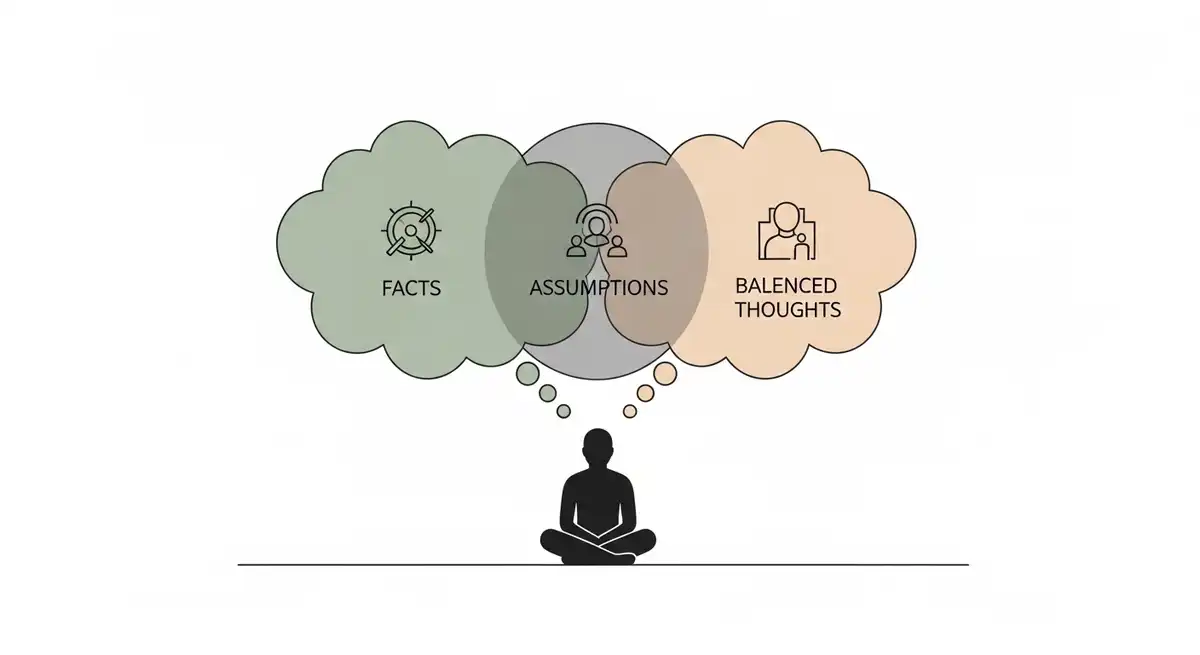
Cognitive restructuring is an educational technique that encourages examining thoughts rather than accepting them automatically. It involves identifying a self-critical thought and separating facts from interpretations. This process supports clarity without forcing positive thinking.
In everyday use, people may write down a thought and list evidence for and against it. This highlights gaps between perception and reality. Over time, repeated practice supports more balanced internal dialogue.
Wellness educators emphasize that restructuring is about curiosity, not argument. It encourages fairness and perspective. Used gently, it supports emotional steadiness while respecting lived experience.
Practicing Cognitive Defusion in Daily Routines
Cognitive defusion focuses on changing the relationship with thoughts rather than their content. It teaches people to notice thoughts as mental events that arise and pass. This reduces the sense of being controlled by internal language.
Simple defusion practices include labeling thoughts or acknowledging them neutrally. Noticing a critical phrase without responding emotionally often reduces its intensity. Many people find this helpful during busy or stressful moments.
Defusion is commonly used as a mindfulness-based lifestyle skill. It does not aim to eliminate thinking but to reduce over-identification. Practiced regularly, it supports psychological flexibility in daily life.
Shifting Focus from Self-Esteem to Self-Compassion
Traditional self-esteem models rely heavily on achievement and approval. When circumstances change, self-esteem can fluctuate sharply. Wellness educators increasingly highlight self-compassion as a steadier foundation.
Self-compassion involves responding to difficulty with understanding rather than judgment. It recognizes that imperfection is part of shared human experience. This perspective reduces isolation and emotional strain.
Importantly, self-compassion does not remove accountability. It encourages learning without shame. Many people find this approach supports consistency and resilience more effectively than self-criticism.
Core Principles of Self-Compassion
Self-kindness refers to speaking internally with respect during moments of difficulty. Instead of harsh correction, language becomes supportive and realistic. This reduces emotional load while maintaining responsibility.
Common humanity reminds individuals that struggle is universal rather than personal failure. Recognizing shared experience reduces isolation. This principle is especially relevant for parents and working adults under pressure.
Mindfulness within self-compassion involves noticing thoughts and emotions without exaggeration. It allows awareness without rumination. Together, these principles support balanced emotional awareness.
Managing Triggers That Activate Self-Criticism
Self-critical thoughts often arise in predictable situations such as performance feedback, time pressure, or conflict. Identifying these triggers increases preparedness. Awareness allows intentional response instead of automatic reaction.
Physical sensations often appear before mental criticism, such as tension or shallow breathing. Noticing these early signals supports timely grounding. Simple adjustments can reduce escalation.
Developing a coping plan for known triggers supports consistency. This may include pausing, reframing expectations, or taking brief breaks. Such plans are practical lifestyle tools rather than therapeutic interventions.
Writing as a Supportive Self-Reflection Practice
Writing from a compassionate observer perspective helps externalize internal dialogue. This practice allows individuals to view situations with greater fairness and context. It is commonly used in reflective journaling.
The process involves describing a challenge and responding as a supportive friend might. This shifts tone without denying difficulty. Many people find this helpful during periods of self-doubt.
Writing practices are flexible and accessible. They require minimal time and can adapt to different schedules. Consistency matters more than length for benefit.
The Three-Chair Reflection Method Explained
The three-chair method is a structured reflection exercise used in wellness education. It separates critical thoughts, emotional responses, and balanced observation. This structure clarifies internal dynamics without judgment.
By giving each perspective space, individuals often recognize protective intentions beneath criticism. This insight reduces internal conflict. Awareness supports calmer internal dialogue.
This method is usually practiced briefly and privately. It supports emotional clarity without replacing professional care. Used occasionally, it enhances self-awareness.
Building a Personal Strengths Inventory
Focusing only on shortcomings reinforces self-criticism. A personal strengths inventory balances this by documenting capabilities and values. It emphasizes observable actions rather than abstract praise.
This inventory may include qualities like persistence or fairness demonstrated in daily life. Recording specific examples increases credibility. Over time, this practice counters negativity bias.
Strengths inventories support realistic self-perception. They do not deny challenges but provide context. Many working adults find this grounding during high-pressure periods.
Accepting Good Enough as a Lifestyle Skill
Perfectionism often fuels negative self-talk by setting unrealistic standards. Accepting good enough recognizes practical limits. This approach supports sustainability rather than constant strain.
Good enough does not mean careless effort. It means aligning expectations with available time and energy. This mindset is especially relevant for caregivers and professionals managing multiple roles.
Practicing good enough reduces burnout risk. It allows rest without guilt. Over time, this supports long-term wellbeing.

When Additional Support Is Appropriate
Lifestyle practices support emotional wellbeing but are not substitutes for professional care. Persistent distress or functional impairment warrants professional evaluation. Seeking help reflects responsibility, not failure.
Therapies such as CBT, ACT, and IFS are commonly used to address self-criticism. These approaches are delivered by trained professionals and provide structured support.
Wellness education encourages recognizing limits. Combining self-awareness practices with professional support when needed promotes safety and effectiveness.
Parenting and Working Life Considerations
Parents and working adults often experience intensified self-criticism due to role expectations. Balancing responsibilities can trigger unrealistic standards. Awareness helps normalize these pressures.
Modeling balanced self-talk benefits children and colleagues. Calm self-correction demonstrates resilience. This supports healthier relational environments.
Integrating small practices into daily routines increases feasibility. Brief pauses and realistic planning fit busy schedules. Consistency matters more than duration.
Frequently Asked Questions
Why is my inner critic so persistent
The inner critic persists because it is a learned mental habit reinforced over time. The brain favors familiar patterns, even uncomfortable ones. Consistent awareness and balanced response strategies gradually reduce its influence.
How can self-criticism affect daily functioning
Self-criticism can increase stress perception and mental fatigue. It may reduce focus and enjoyment of routine tasks. Addressing internal language supports clearer thinking and steadier emotional responses.
Is mindfulness commonly used for self-criticism
Mindfulness is often used as a supportive lifestyle practice for noticing thoughts without over-identifying. It encourages observation rather than suppression. This approach supports emotional balance without replacing professional care.
Can self-compassion reduce accountability
Self-compassion supports accountability by reducing shame-based avoidance. It allows learning from mistakes without self-attack. Many people find this approach encourages steady effort.
How long does change usually take
Changes in self-talk develop gradually through repeated practice. Some people notice shifts within weeks, while others take longer. Consistency matters more than speed.
Is professional support ever necessary
Professional support is appropriate when distress becomes overwhelming or persistent. Lifestyle practices complement but do not replace clinical care. Seeking help supports safety and wellbeing.
Conclusion
Learning how to overcome self-criticism and negative talk is a gradual process grounded in awareness, fairness, and consistency. By understanding internal habits and responding with balanced practices, individuals support steadier emotional experiences in everyday life. These approaches offer practical tools for navigating challenges with clarity, respect, and sustainability.
Medical Disclaimer
This content is for informational purposes only and does not constitute medical or mental health advice. It is not intended to diagnose, treat, cure, or prevent any condition. Consult a qualified healthcare or mental health professional for personalized guidance or concerns.
For wider background on this, see the National Heart, Lung, and Blood Institute on sleep.